01 — The Institute
Three dimensions of technological sovereignty
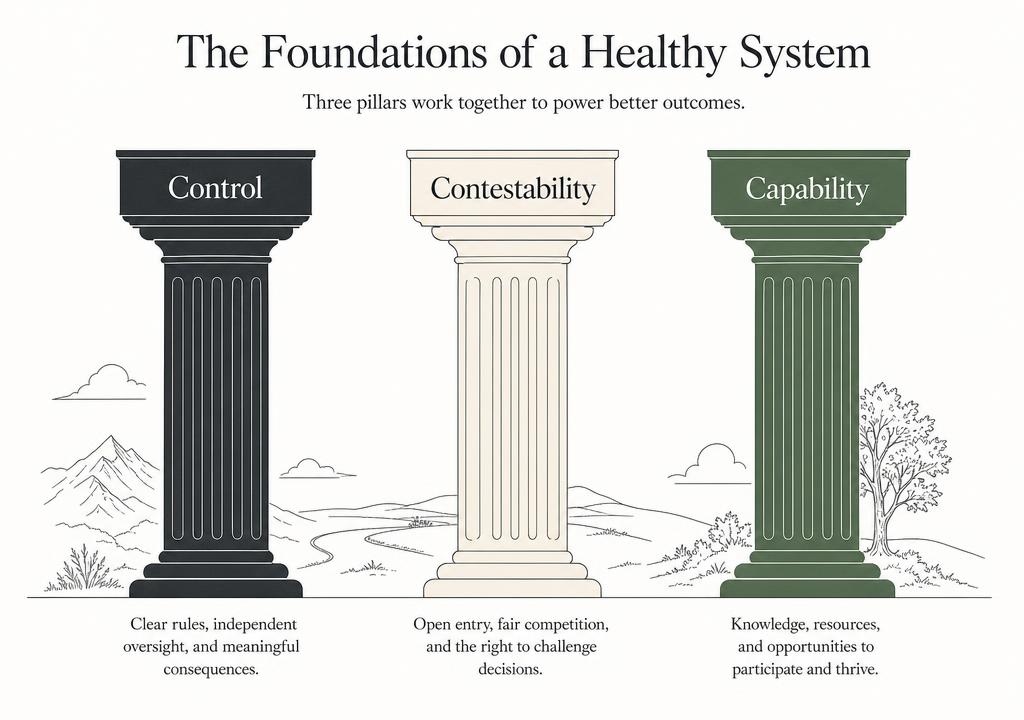
Technological sovereignty is often reduced to a single objective. Yet it rests on three distinct and complementary dimensions.
The first is control. Europe must retain authority over the technologies, infrastructures, cloud services and data that are critical to its security, economy and democratic institutions.
The second is contestability. Sovereignty also depends on the ability to change providers, move data and cloud workloads, and avoid irreversible technological lock-in. Europe is not sovereign where governments and firms have no credible exit option.
The third is capability. Europe must possess the scientific, financial, industrial and technological capacity to develop, scale and control strategic technologies of its own.
These three dimensions answer three different questions: Who controls? Can Europe leave? Can Europe build?
None is sufficient on its own. European ownership without contestability may merely replace a foreign monopoly with a domestic one. Replacing dependence on a hyperscale cloud provider with dependence on a single European provider would not, by itself, create sovereignty. A monopoly remains a monopoly, and users remain locked in.
Contestability without European capabilities may allow Europe to move between providers while remaining structurally dependent on foreign technologies.
Technological capability without control over critical infrastructures, cloud services and data may likewise fail to provide genuine strategic autonomy.
The European Tech Sovereignty Institute studies how these three dimensions can be combined into a coherent European strategy. Its research examines how political choices, economic conditions, industrial policy and European law can enable Europe to control critical technologies, preserve its freedom of action and build strategic technological capabilities of its own.
The Institute focuses particularly on artificial intelligence, cloud computing, compute infrastructure, semiconductors, data and critical digital infrastructure.
Operating model
An institute that thinks like a research centre, creates like a company and acts like a non-profit association.
These three dimensions are not merely analytical categories. They define the kind of institution Europe needs if sovereignty is to become something more than a slogan. The European Tech Sovereignty Institute was designed accordingly.
It is not a conventional research centre, nor a commercial company, nor a traditional non-profit association. It is designed to combine the intellectual freedom of an academic institute, the execution capacity of an enterprise and the public-interest mission of a civic association.
Why this hybrid form? Because studying technological sovereignty is no longer enough. Europe also needs institutions capable of designing, prototyping and deploying concrete alternatives to the centralised models that dominate today's digital economy.
An ordinary think tank produces analysis. A company sells products. A non-profit association campaigns or serves a community. The Institute occupies a different space: it produces rigorous research, builds practical tools and acts in the public interest while preserving its independence from both public and private capture. Funding is a motor — it lets us move fast and hire talent — but the destination is collective utility, not private profit.
This is the reasoning behind our local AI project. We do not wish to complain about foreign hyperscalers while remaining dependent on them. We want to demonstrate that another path is technically possible, economically viable and legally sound: an artificial intelligence that belongs to the individual, runs locally, and keeps personal data under the user's exclusive control.
This hybrid form means we can raise resources, assemble teams, prototype hardware and distribute tools without waiting for a traditional public procurement cycle or surrendering our mission to a single shareholder. We can be fast like a company, rigorous like a research centre, and accountable like an association driven by a public-interest purpose.

Observations
This hybrid model is not an abstraction. It responds to four concrete observations about where Europe actually stands.
First, Europe has developed the world's most sophisticated body of technology law while remaining deeply dependent on foreign technological capabilities.
Second, Europe does not suffer from a shortage of talent or research. Its persistent weakness lies in its inability to scale technological firms into global champions.
Third, technological sovereignty does not require technological autarky. Interdependence is inherent in an interconnected economy in which goods, services, capital and technologies circulate across borders. The objective is not to eliminate foreign dependencies. The aim is to prevent them from becoming excessive in sectors that are critical to Europe’s security, economy and democratic resilience, while strengthening the position of European industries within global value chains.
Fourth, public investment alone will not achieve that objective. Europe also needs a legal and institutional framework that enables innovation, scaling and industrial development across the Single Market.
Scope
One objective, three perspectives.
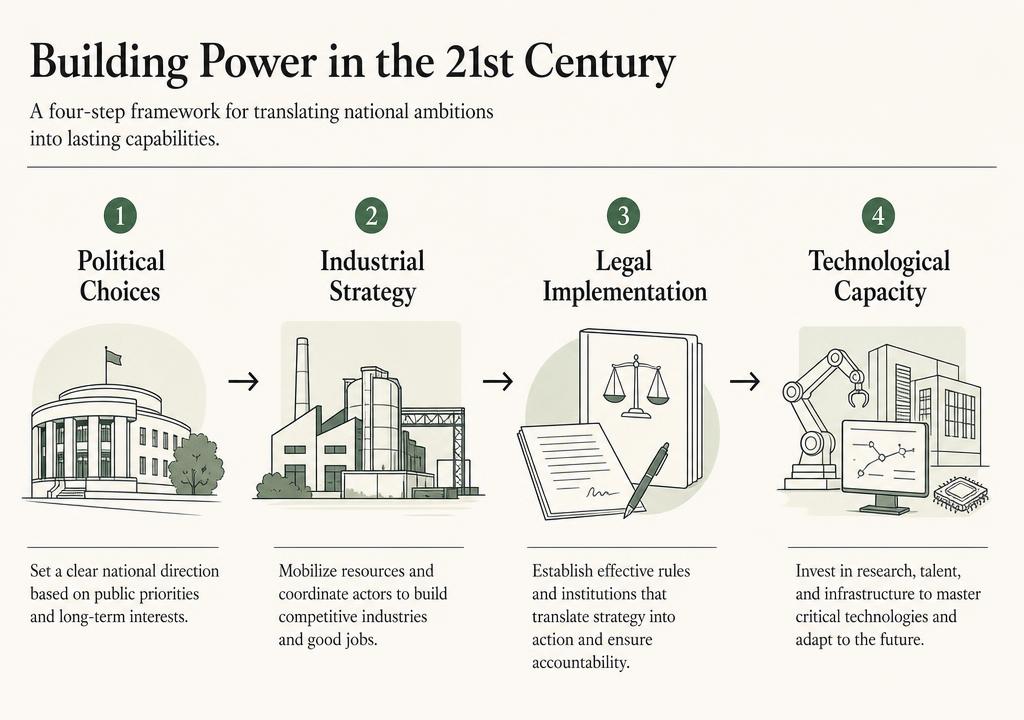
From these observations follows a single research question: how can Europe move from political intention to technological capacity?
Political choices → industrial strategy → legal implementation → technological capacity.
Our research examines how Europe can build, scale and control strategic technological capabilities. This requires bringing together three perspectives that are too often treated separately.
The political perspective identifies the dependencies Europe considers critical, the capabilities it seeks to develop and the degree of autonomy or interdependence it aims to achieve.
The economic and industrial perspective examines the conditions under which those capabilities can emerge and grow: investment and access to capital, innovation and scaling, Public demand, infrastructure, and Europe's position within global value chains.
The legal and institutional perspective analyses how these political priorities and economic conditions are translated into rules, incentives and governance structures. It extends beyond EU technology regulation to the full spectrum of economic law, including corporate law, intellectual property, competition law, contract and liability law, Public procurement, foreign investment and state aid.
These perspectives are inseparable. Political objectives shape industrial policy; industrial policy relies on legal instruments; and law determines whether European firms can innovate, finance their growth and scale across the Single Market.
Positioning — what sets us apart
Neither an advocacy think tank nor a traditional academic centre.
Because we move across law, economics, politics and technology, we occupy a specific place in the European debate. We are not a lobbying group, a government agency or a purely academic centre. Our work is guided by three commitments.
Independent
A legal research institute — not a lobby, not an interest group.
Rigorous
Analysis anchored in law, economic reality and institutional practice.
Purposive
One test for every instrument: does it strengthen European technological sovereignty?
Rather than asking whether Europe regulates too much or too little, we ask a different question: does European law strengthen Europe's technological sovereignty? The answer determines whether Europe needs more regulation, less regulation, or different regulation.
Co-founders
The people behind the Institute
This vision is carried by a small founding team that combines legal scholarship, quantitative research and hands-on technological work.

Godefroy de Boiscuillé
Associate Professor of Law (Nice Sophia Antipolis), Member of the Institut Universitaire de France (IUF), Chair in Competition, Artificial Intelligence and Digital Sovereignty

Florian Guichard
Statistical Engineer (ENSAI) and certified Mathematics teacher at Sorbonne University (L3).